
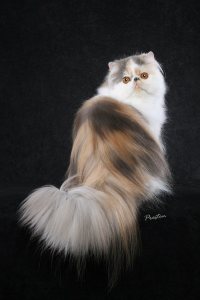
The Persian is an absolutely gorgeous breed that has held the attention of cat enthusiasts since their discovery in the 1600s. This docile, affectionate breed is a wonderful choice for families and couples who have time for regular grooming.
This is an especially sweet breed, known for its docility and affection. The Persian is social, gentle, and enjoys the company of other animals and humans. They need tranquility and enjoy solitude at times. They can be playful, but are rarely aggressive. They have a soft voice that they rarely use. Some Persians are good mousers. Persians live long lives of 15 or more years.
This breed has a well-muscled, round, short body. It is medium to large in size. The legs and tail are short. The head is round and broad. The nose is short, the eyes are large and round, and the ears are small, wide-set, and round-tipped. The Persian face is naturally flat in relation to most other breeds, but has become even flatter through selective breeding. The extreme of this trend is known as the Peke-Faced. Persians weigh approximately 8-15 pounds.
Persians are known for their luxuriant, long, thick coat. The outer coat is loosely fit and the undercoat is dense and wooly. Persians are accepted in just about every color form. The different categories and examples include: Self (White), Smoke (Lilac Smoke), Chinchilla (Golden Persian), Cameo (Red Shell Cameo), Pewter (Pewter), Tabby (Silver Tabby), Tortie Tabby (Blue Tortie Tabby), Tortie (Lilac-Cream), Tortie and White (Blue Tortie and White), Bi-Color Solid (Black and White Bi-Color), Bi-Color Tabby (Brown Tabby and White), Van Bi-Color (Red and White Van), Van Tricolor (Tortie and White Van). Persians with a colorpoint form (markings like the Siamese) are known as Himalayans.
Persians should be provided with a scratching post if kept indoors. However, adult Persians are not very active or destructive.
Most Persians are healthy cats. However, Persians have several health risks. Due to their large, protruding eyes, they are susceptible to eye infections, injuries, and irritations. Due to the flat nature of their faces, they sometimes have breathing problems or problems with clogged tear ducts. Deafness is common with white Persians, especially those with blue eyes.
This is an especially sweet breed, known for its docility and affection. The Persian is social, gentle, and enjoys the company of other animals and humans. They need tranquility and enjoy solitude at times. They can be playful, but are rarely aggressive. They have a soft voice that they rarely use. Some Persians are good mousers. Persians live long lives of 15 or more years.
This breed has a well-muscled, round, short body. It is medium to large in size. The legs and tail are short. The head is round and broad. The nose is short, the eyes are large and round, and the ears are small, wide-set, and round-tipped. The Persian face is naturally flat in relation to most other breeds, but has become even flatter through selective breeding. The extreme of this trend is known as the Peke-Faced. Persians weigh approximately 8-15 pounds.
Persians are known for their luxuriant, long, thick coat. The outer coat is loosely fit and the undercoat is dense and wooly. Persians are accepted in just about every color form. The different categories and examples include: Self (White), Smoke (Lilac Smoke), Chinchilla (Golden Persian), Cameo (Red Shell Cameo), Pewter (Pewter), Tabby (Silver Tabby), Tortie Tabby (Blue Tortie Tabby), Tortie (Lilac-Cream), Tortie and White (Blue Tortie and White), Bi-Color Solid (Black and White Bi-Color), Bi-Color Tabby (Brown Tabby and White), Van Bi-Color (Red and White Van), Van Tricolor (Tortie and White Van). Persians with a colorpoint form (markings like the Siamese) are known as Himalayans.
Persians should be provided with a scratching post if kept indoors. However, adult Persians are not very active or destructive.
Most Persians are healthy cats. However, Persians have several health risks. Due to their large, protruding eyes, they are susceptible to eye infections, injuries, and irritations. Due to the flat nature of their faces, they sometimes have breathing problems or problems with clogged tear ducts. Deafness is common with white Persians, especially those with blue eyes.


 Posts
Posts


0 comments:
Post a Comment