Saturday, September 6, 2008

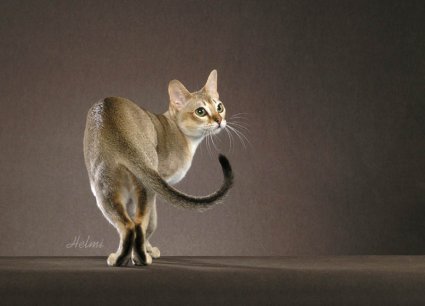
Singapura Cat

http://www.pictures-of-cats.org/images/singapura-1st.jpg

The Singapura is a small cat and a newer addition to the United States show ring. There is much confusion as to its origin. The base stock of all the Singapura cats in the United States is just four cats. They all belong to one American breeder. The future of these cats is in question because the gene pool is small. The breed is still being developed in the U.S. The Singapura was recognized in championship standing in 1988. In its second season of show it realized an amazing triumph. It won 22 grand championship titles.

This cat has coloring unlike any other breed. Although small, he has a somewhat stocky body that is muscular. When he stands, his body, legs and the floor form a square. The only acceptable eye colors are hazel, yellow, or green. The eyes and ears must be large. The legs of this cat are thick and muscular. His coat is silky, fine and short. The only grooming required is a combing occasionally.

The only color variety is sepia with ticked fur and you will only see the Singapura as a shorthaired.

The Singapura is a moderately stocky and muscular small to medium-sized cat, with a very short and fine coat. A full grown female usually weighs 5-6 pounds while the male weighs 6-8 pounds. The large, slightly pointed and deep cupped ears together with the large almond shaped eyes are a characteristic of the breed. The tail is slender, slightly shorter than the length of the body and has a blunt tip. This is an active cat that loves to be with his humans. He gets along great with other animals and the female is very loving and maternal with her litters. The Singapura is described by the CFA as active, curious and playful. They are affectionate and desire human interaction. They have a tendency to perch on high places, to allow them a better view of their surrounding.

Sphynx

http://dspace.dial.pipex.com/woozles/Scottie_-_Best_Sphynx_2002.JPG

The Sphynx is a medium-sized, elongated, muscular cat. The body is well-rounded and fully muscular. The back is slightly arched. The legs are in proportion with the body and well-muscled. The tail length is also proportionate with the body. It is slender, and tapering. The head is medium-sized, angular, and slightly triangular. The eyes are large, lemon-shaped, wide-set, and slightly slanted upward toward the ears, which are very large and wide-set. They live to be 10-15 years old and weigh 6-11 pounds.
The main defining feature of the Sphynx is, of course its coat, or lack there-of. The Sphynx is known as being hairless, but that is not completely true. It is covered in fine down, making it feel like a warm peach or suede fabric. Short, fine hair is sometimes present on the tail, feet, nose, and cheekbones. Wrinkled skin is desirable, but not excessively. The Sphynx is accepted in all color variations, which can be seen in the skin pigmentation and fine hair.
With its excessively large ears, thin whippy tail, and nearly hairless body, the Sphynx is a truly unique breed. In contrast with its extreme appearance, this breed has a pleasant, even temperament. Shpynx admirers regard it as being "part monkey, part dog, part child, and part cat", while others have described it as being "the ugliest creature alive" and "a creature with a hairless body, a snake's head, a rat's tail, and earl like bats' wings
The Sphynx Cat coat is not precisely hairless. These cats do have a fine suede-like coat that is soft and warm to the touch. There may be areas of fur on the tip of tail. above the brown or around the toes. The Sphynx Cat has a large wide head with a slender neck. The ears are set tall and open. They have large eyes that are slightly slanting and high rounded cheekbones. The legs are long with thick rounded paws. The tail is long. slender and whip-like. The skin may be wrinkled between the ears. around the muzzle and shoulders. Most of the time they do not have whiskers. The Sphynx is a medium-sized cat that is sturdy and well-built cat.
The Sphynx Cats coat comes in a variety of colors and patterns. These colors include white. black. blue. red. cream. chocolate. lavender. cinnamon. fawn. blue-cream. lavender-cream. fawn-cream. sable. champagne and platinum. The tabby cats are silver. brown. blue. red. chocolate. chocolate-silver. cinnamon. lavender. lavender-silver. fawn and cream. The tabby pattern cats are classic. mackerel. spotted. and patched. The Tortoiseshell cats are chocolate or cinnamon. The Calico cats are fawn-cream. lavender-cream. cinnamon-cream. fawn-cream van. lavender-cream van. cinnamon-cream van. van. dilute. or dilute van. The Bi-color cats are solid color and white. tabby and white. tortoiseshell and white. pointed and white. any color and white. The Van bi-color cats are solid color and white. tabby and white. tortoiseshell and white.
The Sphynx is considered to be a shorthaired cat. The Sphynx cats are very smart. playful. and lively companions. People that are allergic to cats may be able to tolerate this hairless breed. The Sphynx does need regular care and cleaning of its skin. because when the Sphynx sweats greasy detritus can build up. If this cleaning of the skin is neglected. the detritus has to be sponged or even scraped away. The Sphynx cats may develop lumps and are prone to allergies. The International Cat Association recognizes the Sphynx as a breed. however many registering organizations refuse the Sphynx stating that the cat is a genetic malformation. The Sphynx cats are rare and breeders usually have a waiting list for their kittens.

Somali cat

http://www.catpage.us/images/iamcats-somalis/iamcats-somalis_image1.jpg

This energetic breed is not only a sight to behold, with its luxurious coat and fox-like appearance, but is also an excellent family cat. It is even tempered, social, and playful, which makes it ideal for children. Though it has a beautiful coat, this breed only requires moderate grooming.
Like the Abyssinian, the Somali is extroverted, athletic, very active, affectionate, and playful. It is a good mouser and enjoys running about outside. Somalis love being around people, but can be rather insistent when seeking attention. Some sources state that the Somali is hardly distinguishable in personality from the Abyssinian, while others say it is calmer and less demanding. This is an intelligent breed that often opens cupboards, and can even learn to turn on faucets. The Somali is sensitive to the cold, and some even appear to be afraid of the cold. This breed has a soft voice and is usually quiet. Since the coat is of medium length, it only requires weekly grooming most of the year and daily grooming during shedding season.

http://www.acfacats.com/images/Vertical%20Somali.jpg
The Somali is prized for its fox-like appearance, which is created by the medium length of its ticked coat, fluffy tail, ruff (thick collar), and large tufted ears. Other than the coat length and tufted ears, the Somali is very similar to the Abyssinian. It is medium-sized, slender, and long with a muscular build. The back is slightly arched, making it appear like it is readying to leap into the air. The head is a slightly rounded wedge. The markings on the face create the appearance of a mask and smile. The eyes are large and almond-shaped and the ears are large and moderately pointed. The legs are long and thin. The tail is of moderate length, is thick at the base, and slightly tapers. They weigh approximately 9 to 16 pounds and live approximately 12 years.
The Somali has a semi-long coat with a thick undercoat. Like the Abyssinian, each strand of the Somali's coat has different bands of color, which is referred to as being "ticked". The Cat Fancier's Association, the main cat association in the United States, only recognizes the more wild looking color variations: Ruddy, Red, Blue, and Fawn. The Governing Council of the Cat Fancy, the main cat association in England, accepts those colors, along with Sorrel, Chocolate, Lilac, and Cream. It also accepts Tortie, Silver, and Tortie Silver varieties of those colors. The silver varieties are characterized by a white undercoat.
This breed craves exercise and activity. It needs time to run about outside. It also needs toys and a scratching post for indoors.

Snowshoe (cat)


The Traditional Snowshoe can be described by its short hair, four white feet that extend over its ankles, and a white "v" shaped marking over the nose and muzzle. The head is shaped like a modified triangle. Its body is muscular but not overly so. It has the conformation of a runner. The white pattern should not cover more than two-thirds of the body. Males are larger in size than females; they can weigh as much as 12 pounds. It is considered a medium to large cat with bright blue eyes. The eyes are oval in shape when the cat is undisturbed but when alerted, the eyes are walnut in shape. The name of Snowshoe originated because of the combination of points and white patterns on its feet.
Snowshoe cat is a medium-size cat, the Snowshoe combines the stocky, robust appearance of the American Shorthair with the length of the Siamese. The pleasing result is a powerful, agile cat of intermediate body type.
The head is a rounded wedge shape, the eyes are oval and bright blue, and the ears are medium-size, with slightly rounded tips.The Snowshoe is a shorthaired cat with a pointed coat pattern, white markings on the feet (for which the breed is named), and an inverted white "V" on the face, which begins in the middle of the forehead and descends to the muzzle.

These cats come in two colour combinations: seal point and white, and blue point and white.
As with all cats, their individual personalities vary, however, overall the Snowshoe is a friendly cat that manages to retain the astute intelligence along with just a touch of the mystic aloofness provided by their Oriental ancestors.
An inquisitive and active cat, the Snowshoe offers many hours of delightful entertainment and a cats lifetime of affectionate companionship.


Russian blue

http://www.harmuan.net/Pennut158.jpg

The Russian Blue is known for its affection and serene disposition. It is well-loved for its elegant, yet simplistic appearance. This breed requires little grooming, yet remains stunning at all times.
This is an extremely affectionate breed that loves being around people, including strangers, and other cats. The Russian Blue is also known for being quite gentle and serene. However, some have described it as a temperamental cat. It enjoys staying inside and can be either playful or sedentary, depending on its particular personality. The Russian Blue is also known for being less destructive than other breeds. This breed has a very soft, sweet voice and requires little maintenance.

The Russian Blue has a medium-size, slender, elongated, and well-muscled body. The legs are long and slender with round paws. The tail is long, thin, and tapering. The head is wedge-shaped and of medium size. In Britain, the head is rounder than in America. The eyes are large, almond-shaped, and green. The nose is medium length and the ears are large, wide-set, and moderately pointed. The Russian Blue's weight ranges from 7 to 12 pounds, though it is slightly heavier in Britain. They live to be approximately 13 to 15 years old.
Obviously, this breed is known for its blue coat, which can range from light to dark gray with a silvery sheen. However, White, Black, and Red variations are accepted in some countries. They are referred to as Russian Whites, Russian Blacks, and Russian Reds. The coat is short and dense, due to the double coat, consisting of an outer coat of strong guard hairs and an inner coat of water-resistant down hairs.
This breed can be playful or lack the need for activity. However, if it becomes overweight, it should be encouraged to play and exercise.

Ragdoll cat

http://bellapalazzo-ragdollcats.com/P/VillaroyalMiles.jpg

The Ragdoll cat, a semi-longhaired cat, is noted not only for its sturdy body, short legs, and thick and silky coat, but also its Siamese-style color points (that is, brown coloring on the ears, face, tail, or legs). They are a larger cat, with males weighing in at approximately 15 to 20 pounds, but the Ragdoll is definitely a gentle giant. Ragdolls come in 6 different colors - seal, chocolate, flame, and "dilutes" blue, lilac and cream. There are 3 different patterns: Pointed (nose, ears, tail and paws in the specific colors & no white), Mitted - white paws, chin and tummy, with or without a blaze (a white line on the face), and Bicolor - white tall socks, white inverted 'V' on the face, white tummy and often white patches on the back. Variations include a three-color "tortie-point" (mottled seal or blue with red present) and lynx (striped pattern on tail, face and points) which can be found in all 3 patterns.

What a Ragdoll is really known for is how it will go limp when held or picked up. The Ragdoll is an extremely placid breed. Their gentle and docile nature makes them a wonderful pet for families who are worried about child or infant safety. However, because the Ragdoll can be so docile, it's recommended to keep them as indoor cats because they will often not defend themselves.

The Ragdoll loves to be with people, and can be very affectionate and doting. The Ragdoll will often follow their owners around, or wait by the door for you to come out of a room. Because of their short legs, the Ragdoll is not very athletic, but it still loves to play, and will most certainly let you know when it's play time.

They were first bred in the 1960s by a Persian breeder in California. Bred specifically for their size and gentle demeanor, the Ragdoll's unique personality is the result of years of selective breeding.

Some of the original stock consisted of hardy, free-roaming street cats. Ms. Baker created the foundations of the Ragdoll breed by selecting kittens out of Josephine, a semi-feral longhaired white female Persian/Angora type, sired by several unknown male Birman-like or Burmese-like cats, one with Siamese type markings. Out of those early litters came Blackie, an all black Burmese-like male and Daddy Warbucks, a seal point with white feet. Daddy Warbucks sired the founding bi-color female Fugianna, and Blackie sired Buckwheat, a dark brown/black Burmese-like female. Both Fugianna and Buckwheat were daughters of Josephine. All Ragdoll and RagaMuffin cats are descended from Ann Baker's cats through matings of Daddy Warbucks to Fugianna and Buckwheat. By selecting individuals with the look and temperament she wanted for her breeding program, Ann Baker created the standard Ragdoll type.

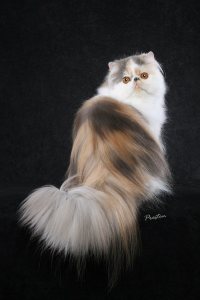
Persian Cat

http://img512.imageshack.us/img512/1150/persiankitten1da5.jpghttp://i.b5z.net/i/u/824630/i/Img81.jpg

The Persian is an absolutely gorgeous breed that has held the attention of cat enthusiasts since their discovery in the 1600s. This docile, affectionate breed is a wonderful choice for families and couples who have time for regular grooming.
This is an especially sweet breed, known for its docility and affection. The Persian is social, gentle, and enjoys the company of other animals and humans. They need tranquility and enjoy solitude at times. They can be playful, but are rarely aggressive. They have a soft voice that they rarely use. Some Persians are good mousers. Persians live long lives of 15 or more years.
This breed has a well-muscled, round, short body. It is medium to large in size. The legs and tail are short. The head is round and broad. The nose is short, the eyes are large and round, and the ears are small, wide-set, and round-tipped. The Persian face is naturally flat in relation to most other breeds, but has become even flatter through selective breeding. The extreme of this trend is known as the Peke-Faced. Persians weigh approximately 8-15 pounds.
Persians are known for their luxuriant, long, thick coat. The outer coat is loosely fit and the undercoat is dense and wooly. Persians are accepted in just about every color form. The different categories and examples include: Self (White), Smoke (Lilac Smoke), Chinchilla (Golden Persian), Cameo (Red Shell Cameo), Pewter (Pewter), Tabby (Silver Tabby), Tortie Tabby (Blue Tortie Tabby), Tortie (Lilac-Cream), Tortie and White (Blue Tortie and White), Bi-Color Solid (Black and White Bi-Color), Bi-Color Tabby (Brown Tabby and White), Van Bi-Color (Red and White Van), Van Tricolor (Tortie and White Van). Persians with a colorpoint form (markings like the Siamese) are known as Himalayans.
Persians should be provided with a scratching post if kept indoors. However, adult Persians are not very active or destructive.
Most Persians are healthy cats. However, Persians have several health risks. Due to their large, protruding eyes, they are susceptible to eye infections, injuries, and irritations. Due to the flat nature of their faces, they sometimes have breathing problems or problems with clogged tear ducts. Deafness is common with white Persians, especially those with blue eyes.

Javanese

http://farm3.static.flickr.com/2215/1684360036_2cb61b4ad3.jpg?v=0

Color - Ranges from cream, red, lynx points, and parti-color points.

Eyes - Deep vivid blue

Appearance - The slender lines and flowing coat hide a rock hard body capable of amazing feats of acrobatic proportions. The Javanese has a medium length, fine, silky coat, without downy undercoat. The coat lies close to the body, and may appear shorter than it really is. Their markings can vary from a soft sprinkling of red and cream on a background of seal, blue, chocolate or lilac, to bold splashes of color, sometimes creating a clown-like appearance.

Personality - The Javanese cat is a breed for folks who waant a little spice in their lives. Javanese are a study of contradictions - elegant refinement, sometimes fragile in appearance in reality hard and muscular with surprising strength. Highly intelligent, they become familiar with their human's routine. They will "talk", gently reminding when you are late with meals or play time, joyously greeting you whenever you have been away. As a rule, the Javanese voice is softer and gentler than the Siamese. They use their paws like little hands to open cabinets and drawers in search of a favorite toy they saw you hide.

Breed Fact - Tortie points are the Javanese version of a dizzy blond or crazy redhead acting almost as if, between the splashes of red and cream mixed with the background color, they can't make up their minds how they are supposed to behave. They "speak" their minds freely and entertain you with their antics. If Lucille Ball was ever reincarnated as a cat, she would definitely be a tortie!

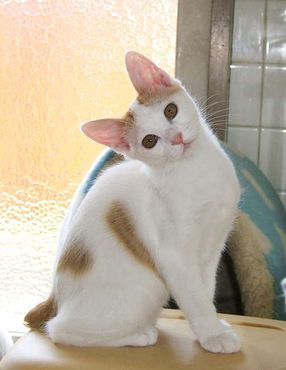
Japanese bobtail

http://www.catsforyou.com/images/japanese%20bobtail.jpg
The Japanese Bobtail is known as a Japanese symbol of good luck when possessing the traditional three colors of black, red, and white. It is a loving, playful cat that enjoys being with the whole family. This breed requires little grooming and has a soft, harmonious voice.
Japanese Bobtails are especially affectionate cats that enjoy living with families. They are playful and good with children. The Japanese Bobtail enjoys talking with its owner in its soft, melodious voice that some characterize as "singing". Some say that this breed enjoys having other cat companions, while others say that it does not get along with other cats. This breed generally ignores dogs, but is likely to be interested in other small pets, since it is known as a good hunter. Some have been known for enjoying the water. The Japanese Bobtail requires minimal grooming.
The main defining characteristic of the Japanese Bobtail is, of course, its tail. The tail is 5-10 cm (2-4 inches) long and is curved, angled, or kinked. It can be flexible or rigid. The fur covering the tail is fluffy and thicker than the fur on the rest of the body, creating a "pom-pom" appearance.
The body of the Japanese Bobtail is medium-sized, lean, and muscular. The legs are slender, with the hind legs being longer than the front legs. The paws are long, thin, and oval. The head forms a nearly perfect equilateral triangle. The ears are large, wide-set, and at right angles to the head. The eyes are oval shaped and wide-set as well, and the nose is long. The coat is medium-length (or long length for the long-haired Japanese Bobtail), and all color forms are acceptable, except the Siamese and Abyssinian colors. However, the favored color types include the following: black, red, and white (Mi-Ke); black, red, and cream (tortoiseshell); black and white, red and white, tortoiseshell and white; white; black; red. This breed is one of the lighter breeds, weighing 6-9 pounds. The average lifespan is 9-15 years.
This is an active breed that enjoys playing. It should be provided with toys and play time with its owner. It can enjoy exercise indoors or outdoors.

Himalayan Cat

http://www.catsofaustralia.com/persianvicki.jpg

The Himalayan cat is one the few feline breeds which has a very well-described ancestry.
The Himalayan has the stocky body type, long hair, and placid temperament of the Persian, but has the pointed pattern of the Siamese.
The Himalayan cat is said to have a gentle disposition like other Persian cats, but may clown around more to get attention and affection from their human companions. Himalayans may also be more active than most Persians due to the Siamese element in their background. They may destroy household objects if left alone too much due to boredom. Himalayans are said to like to be involved in their humans' daily lives and chores.
Coming from a Persian and a Siamese it is rather interesting that the standards dictate a rather round, short and stubby sort of appearance. The head of a Himalayan cat should be round and be rather large when compared to the body. Instead of a longer neck it needs to be short and stout. As fitting for a head and neck configuration such as this the eyes need to be large and round while being set widely apart.
Continuing the consistency of the standard; the body should resemble the head characteristics. A solid body of medium to large size and a broad rear end should comprise the main body. The legs need to be short to the point of being stubby. Rounded feet finish off the Himalayan cat body.

The fur on a Himalayan cat needs to be either long and silky or short and dense. The color of the fur on the main body should be varying shades of white. Color-points should be restricted to the face mask, legs, tail, feet and genitals. To say that the color-points are varied is an understatement although most fall into a description of the Lynx color category. The lynx colors accepted include: seal, blue, red, cream, tortie, blue-cream, chocolate, lilac, chocolate-tortie and lilac-cream. Main grouping colors that are accepted include blue, chocolate, cream, red-tortie and seal-lilac.

Havana brown Cat

http://www.gotpetsonline.com/pictures-gallery/cat-pictures-breeders-kittens-rescue/havana-brown-pictures-breeders-kittens-rescue/pictures/havana-brown-0002.jpg

The Havana Brown is a lively, playful cat. They are extroverted and enjoy being around people, though they often become attached to one person. They are curious, and even mischievous, but not overly destructive cats. The Havana loves being inside, and is therefore a good apartment cat. They have been described as being both reservedly affectionate and exceptionally sweet, which may be a product of becoming attached to one person. The Havana's voice is medium in volume and pitch. This breed requires little grooming.
The defining feature of the Havana Brown, as signified by its name, is of course its uniformly brown coat. Even the nose and whiskers are brown. All shades of chestnut brown are acceptable. The coat is medium in length, glossy, and smooth.
The body is medium in length and muscular, but not stocky. The legs are medium in length and the tail is medium long. In Britain, the Havana Brown has a more Siamese appearance than in the United States. In Britain, the head is triangle-shaped and the nose is long and straight. In the United States, the head is rounder in shape and the nose is shorter. In both countries, the ears are large and the eyes are oval-shaped and green. This breed weighs 6-10 pounds and lives to be approximately 9-15 years old.
The Havana Brown is particularly elegant with its uniformly chestnut coat from the tip of its nose to the tip of its tail. It is an active, playful cat that enjoys the indoors. It is especially friendly and affectionate with its owner.

Exotic Shorthair

http://www.maplebayexotics.com/creamblackout.jpg

The Exotic Shorthair Cat has a coat that is medium in length. The coat is soft. dense and plush. The undercoat is thick and the hair is not close lying. The large eyes are round and bright setting level and apart. The color reflects the color of the coat. The small ears are slightly forward and round tipped. They are set wide and low on a huge. round head. The Exotic Shorthair cats have a nose that is short and wide with full cheeks. The body is large or medium in size with a wide chest. The legs are short and strong. The tail is short and usually carried with a curve.
The Exotic Shorthair must conform to the Persian standard for type and colour; the difference is in the hair length. The colours and patterns are recognised as for Persians.
Head: Round and massive with great breadth of skull; well balanced. Full cheeks, round forehead.
Short, broad nose with stop centred between the eyes - nose leather broad, with open nasal apertures
Small, round-tipped ears, set wide apart and low on the head, with full ear furnishings.
Strong chin. Broad and powerful jaws.
Short, thick neck.
Large, full, round eyes; brilliant and set wide apart.
Sweet, open expression.
Coat: Dense, plushy, soft in texture; standing out from the body due to density, not lying flat. Slightly longer than the coat of the British Short hair but not long enough to flow. Of uniform length, except in kittens, which may retain guard hairs.

During the 1950's American Short hair breeders decided to cross their cats with Persian's. The Persian breed had become increasingly popular and breeders recognized that they could potentially create American Short hairs with better body types and that they may also inherit the beautiful silver colour in their fur. Like Persians, the hybrids were popular at shows - their heads had become rounder, their noses shorter and there fur longer and silkier.

European burmese

The European Burmese cat has a coat that is short and fine. There is almost no undercoat and the texture is satiny. The large and alert eyes are set apart with a slight slant toward the nose. The eyes are a bright yellow to amber. The medium-sized ears are wide at the base and are set apart with a small forward tilt. The head is somewhat rounded with wide cheekbones and a strong chin. The body is medium in size and length. The chest is strong and the body may be hard and muscular. The European Burmese cats may be heavier than they appear. The legs are slender and the tail length is medium.
The European Burmese is a medium-sized shorthaired cat. These cats are extremely smart. loving and devoted. The European Burmese is an elegant cat that has good bone structure. The eyes are expressive with a sweet facial expression. These cats love people and make great companions. They do prefer the company of other animal. but can adjust to being the only pet.

European Burmese History:
The European Burmese, sometimes known as the foreign Burmese, was developed in the 1960s by British breeders who imported Burmese cats to England and then crossed them with red-point Siamese and British Shorthairs in an attempt to expand the gene pool. By introducing the gene for red, they expanded the number of coat colors in the breed. The European Burmese was recognized by the Cat Fanciers Association (CFA) in 1994. Now, it’s also recognized by the Canadian Cat Association (CCA), Cat Fanciers Federation (CFF), Traditional Cat Association (TCA) and United Feline Organization (UFO). The CCA and CFF register it as the Foreign Burmese.


Devon Rex

http://lh4.ggpht.com/mjbmeister/R-37g383JII/AAAAAAAADJA/rnqQWhmefBQ/s400/devon-rex-Maigh.jpg

The Devon Rex, also known as the "Pixie Cat", for its elf-like features, is an affectionate, active cat. It has an interesting, wavy coat made of down hairs and a few guard hairs. This cat is a great indoor cat for people who enjoy playing and spending time with their cats.
The Devon Rex is a loving, social cat, especially with people. In general, it is friendly with dogs, other cats, and even rodents, but it enjoys being with people the most. It is active and playful, but not as much as the Cornish Rex. They are known for remaining playful even throughout their later years. They are gentle cats that are good playmates for cat-friendly children. Unlike some breeds, this breed does not need time to itself. It enjoys being around people most of the time. Devon Rexes have been described as "dog-like", due to their friendly, human-centered demeanor and various tricks that have been observed in this breed. Some have been taught to fetch slippers and walk on a leash. They have also been observed wagging their tails, but it is now believed that the wagging was serving the purpose of balancing them when they performed difficult tricks, such as walking a tightrope. Like the Cornish Rex, they enjoy being indoors and require minimal grooming. They have a soft, sweet voice, milder than the Cornish Rex's. Like the Cornish Rex, people who are allergic to cats are less likely to experience allergic reactions to the Devon Rex.
the Devon Rex is largely known for its unique wavy coat. The Devon Rex coat is comprised mostly of down hairs, but unlike the Cornish Rex, it has some guard hairs, though they are thinner than the average cat's guard hairs and vary in length. These features create a lumpier, slightly harsher coat than the Cornish Rex coat. Like the Cornish Rex, the Devon Rex also has curly eyebrows and whiskers.
The Devon Rex should be kept inside during cold weather and provided with additional warmth, since its thin coat is often not a sufficient insulator. In the early history of the breed, a hereditary, fatal disease known as "spasticity" was developed, due to inbreeding. However, it has been bred out of current lines. Also, muscular dystrophy and hemophilia have been seen in some Devon Rexes, but breeders have attempted to breed these diseases out.

Egyptian Mau

http://www.pusscats.com/Egyptian_Mau-Cat_1.jpg

The Egyptian Mau is one of the few naturally spotted cats. It has an elegant, long body and a stride like a cheetah. The eyes are oval shaped and vivid green in colour with dark highlighting sometimes referred to as "mascara". There are two stripes on each side of the face next to the eyes, and banding on the legs and tail. The short coat may be one of four base colours (silver, bronze, smoke, or black), all with randomly placed black spots and black striping.
You won't find a more distinctive looking cat than the Mau. It's surprising Maus haven't become the latest unusual pet craze. Plus it's fun to have a cat that directly traces its lineage to the first cats domesticated by humans. (It was actually a two-way street. With agriculture came stored grains, followed by lots of rodents, followed by very grateful cats. They were happy to associate with us - we provided them with an easy, ready supply of food.) As with any breed, watch for the quality of the breeder, buy only from reputable breeders with clean catteries and healthy, friendly cats. The Egyptian Mau is the only natural domesticated breed of spotted cat. The Egyptian's impression should be one of an active, colourful cat of medium size with well developed muscles. Perfect physical condition with an alert appearance. Well balanced physically and temperamentally. Males tend to be larger than females.
Inbred cats have been reported to have a higher incidence of respiratory disease, intestinal disease, and neurologic problems.

The exact origin of the Egyptian Mau is not recorded and therefore cannot be known for certain. The Egyptian Mau is often said to be descended from African wild cats,and a descendant of the cats seen in wall paintings of Ancient Egypt.

The modern Mau is said to have originated in 1953, Italy, when exiled Russian Princess Natalie Troubetskoy met the cat of the Egyptian Ambassador to Italy. She convinced him to obtain several cats from Egypt for her, and she began to breed them. From her the Mau has been described as having a "troubled" look, with their round eyes and open expression. The Mau achieved championship status in some organisations in 1968. There were attempts by British breeders to create Maus from cross-breeds of Abyssinians, Siamese and tabbies, however these did not resemble the true Maus. This "recipe" later became the basis for the Ocicat.

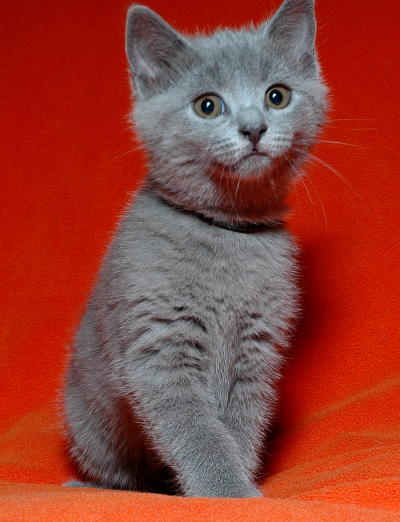
Chartreux

http://www.bluecatfarm.com/A%20Doubting%20Belle%20Fleur1.jpg

The Chartreux is a natural French breed of great antiquity. It is known for its gray-blue color, wooly double coat, powerful build, and mild temperament. Although it is a massive cat, it has a sweet, smiling expression and a tiny voice. It is always gray-blue in color, with gold to copper eyes. Authors through the centuries have praised the Chartreux as a gentle cat, a quiet cat, an excellent hunter, devoted to its master, easy to keep and a good traveler. These characteristics were prized in a working breed, and are still true of the Chartreux today.
The Chartreux is a sturdy French breed coveted since antiquity for its hunting prowess and its dense, water repellent fur.
Broad, rounded head with powerful jaw and full cheeks. Straight nose with a slight depression between the eyes. Comparatively small, tapered muzzle. Sweet, smiling expression. Medium sized ears set high on the head, with a very erect posture. Rounded, open, expressive eyes.
Robust, medium-long body with broad shoulders and deep chest. Solid and dense. Females are medium in size, males are large. Tapering, moderate length tail. Comparatively short and fine-boned legs. Feet are round and appear almost dainty compared to body mass.

The Chartreux Cat is probably the most natural cat breed of them all. This is because her origins appear to go back to the 16th century (see below) and more importantly the objective of modern breeders is to make sure she remains as she has always been. The Chartreux cat breeders deserve recognition for their foresight and unique actions. The cat fancy likes to "improve" cat breeds through selective breeding.

The desire to retain the purity of the breed seems to be a thread running through the history of this breed. This is a great motivator to continue the good work and is probably why the current breeders are dedicated to the preservation of this breed in its original form.

British shorthair

http://www.bestcat.ru/img/dams/dams21_big.jpg

The British Shorthair is a solid, well-built breed. It has a large, muscular, compact body with a broad chest. The large, rounded head that the breed is known for, sits on a short, thick neck. The eyes are large, round, and wide set, the ears are medium sized and also wide set, and the nose is medium sized. The legs and tail are short and the tail is rounded at the end. This breed weighs from 9 to 18 pounds. This is a hardy breed, whose lifespan is 15 or more years.
The British Shorthair has a short, dense, plush coat with a thick undercoat. The most popular British Shorthair color is blue, but this breed is acceptable in almost any color. The many color varieties are classified into 18 categories: Self Colors, Tabby, Silver Tabby, Tabby and White, Silver Tabby and White, Spotted, Silver Spotted, Tortie Tabby, Tortie, Tortie and White, Bi-color, Smoke, Smoke and White, Tipped, Self Pointed, Tortie Pointed, Tabby Pointed, and Tortie Tabby Pointed.
The British Shorthair is an independent cat that does not need constant social interaction, but still enjoys being around people and other animals. It is a friendly, affectionate cat that is loyal to its family and plays well with children.
As mentioned earlier, this breed is not an especially active cat. They usually enjoy sitting and sleeping more than playing or exercising.
British Shorthairs are hardy cats that suffer from no particular illnesses. However, they are susceptible to becoming overweight or obese, like the American Shorthair. To prevent this condition, simply control the amount of food the cat consumes and play with the cat to increase its activity level. You can also feed it a diet formulated for overweight or obese cats. If your cat is obese, it is important to bring it to a veterinarian for a check-up, to rule out any thyroid or metabolic conditions.

Bombay

The Bombay is jet black, sleek, shiny, and exotic, with amazing copper eyes. Being a hybrid of the Burmese and American Shorthair, the Bombay does have some characteristics of both parent breeds, but they also have their distinct characteristics. The Bombay is a solid, muscular, medium-length cat. Their head is rounded, with wide set eyes, and they have a sweet expression. Bombay eyes range from gold to copper, the more copper the better.

The Bombay’s ears are set wide apart and tilt forward slightly, and the tips of the ears should be slightly rounded. The Bombay nose should have a slight break when viewed from the side, but should not be pug nosed by any means. Their coat should be short with very fine, silky hairs. This lends to the glossy coat that they are known for. Overall, the Bombay should appear very well balanced

Bombay Cat Temperament
Bombay kitties are very smart and energetic and learn games and tricks easily. They are calm, friendly, and affectionate but prefer to be Top Cat around the house. Bombays will talk to you, some more so than others. They do like to be involved in whatever you are doing just because they enjoy your company. The Bombay is a very playful breed. If you are interested in a cat that will go on walks with you, the Bombay is often successfully leash trained!

http://www.moggies.co.uk/breeds/bombay.jpg

Bombay Cat Health and Care
Bombays are very low maintenance cats, shedding very little even with the changing of the seasons. Occasional brushing is enjoyed, and bathing isn’t needed very often unless he’s going to be shown. Many breeders smooth and shine their Bombay with a chamois cloth. The Bombay has a healthy appetite, and their food should be high quality and monitored. Most can be free fed without getting overweight.

It is important to note that some Bombay bloodlines carry a genetic defect called Craniofacial Defect, which is a malformation of the skull. Many kittens have to be put down once they are born. If planning to breed Bombay cats, one must be prepared for and able to deal with this occurrence. Some say that the Australian Bombay doesn’t carry this genetic defect and are healthier cats. Though outcrossing is still allowed to Burmese and American Shorthairs, some registries no longer allow outcrossing to the American Shorthair.

California Spangled

http://files.dogster.com/images/catster/breeds/american_bobtail.jpg

General: First impression should be an unmistakably spotted cat, with a long, strong, cylindrical-type body and a hunter-like gait.
Body: Shape long, lean, muscular, well supported; size medium; carriage typically low and even; ample bone without undue bulk; musculature very well developed overall.
Head: Shape sculpted; wide cheekbones; medium length and width; forehead slightly domed; muzzle well developed; chin and jaw strong, fully developed; gentle stop between forehead and nose.
Ears: Base and height approximately equal; rounded tip; size medium; placement high and back from face.
Eyes: Shape open almond; size medium large; placement wide, gently sloping. Color amber to brown, cocoa to gray-brown, sand, or yellow-gray, depending upon coat color. Snow Leopard eyes blue.
Coat: Length short and close across the back, sides, neck, and face; short but slightly longer on tail and underbelly.
Color: Silver/smoke and tabby divisions, spotted pattern only: silver, bronze, brown, gold, red, blue, black, and charcoal. Snow Leopard is a recessive phase of any of the accepted colors.

The idea for the California Spangled Cat came about in the early 1970s after writer and cat enthusiast Paul Casey visited Africa and became concerned about the plight of leopards and other spotted cats, who were poached for their skins. He decided to create a spotted domestic cat to help raise awareness of the need for wild cat conservation. Using only domestic cats—including Abyssinians, American and British Shorthairs, Siamese and spotted cats from Egypt and Malaysia—he began a breeding program to produce a cat that resembled a leopard in miniature. By 1986, he had succeeded, and the cats with the exotic look made their first appearance in the Neiman Marcus Christmas catalog. While there was interest in the cats, they remain rare today. They are registered with The International Cat Association (TICA) and may be outcrossed with domestic long- or shorthairs, Abyssinians, and American and British Shorthairs.

Balinese

Balinese - Cat Facts

Balinese cats are very friendly and social. They generally enjoy being around people and other cats, though they are likely to become more attached to one person than the others. They are affectionate, lively, curious cats. They are active cats that leap like acrobats and enjoy playing. Though the Balinese has a long coat, it requires little grooming, since it does not have a double coat, like most long-haired cats. The Balinese is a loud cat, like the Siamese, but it is slightly less vocal and has a softer voice than the Siamese.
The Balinese is descended from the Siamese, whose origin is not known for sure, but is suspected to have come from Siam (Thailand). It is not known where the first longhaired Siamese cat was born, but the first purposefully bred Balinese was born in the United States. They are no uncommon in the United States, but are still uncommon in Europe.
The Balinese has the same body type as the Siamese, except for its medium to long coat and plumed tail. It has a long, slender, medium-sized body. The head is a long, medium-sized tapering wedge shape. The eyes are almond shaped, medium-sized, and slant towards the nose. The ears are quite large, pointed, and wide at the base. The nose is long and straight. The neck, legs, and tail are long and slender like the rest of the body. It weighs 6 to 11 pounds.
The coat length is medium to long. It is longer on the body, belly, and tail. The fur creates a plume on the tail, which is a prized characteristic of the Balinese. The coat is fine and silky, with no undercoat. The Balinese is accepted in the same colors as the Siamese. These colors include Seal Point, Chocolate Point, Blue Point, and Lilac Point. If they have other color point patterns, such as Red Point and Cream Point, they are known as Javanese. However, in the UK, this separation is not made, and all color points are considered to be Balinese.
This cat is naturally active. It enjoys playing and exploring, but does not generally need a regular play and exercise schedule to maintain its health. It will initiate various activities on its own.

Bengal

http://www.torreymaobengals.co.nz/images/bengal_cat_posing.jpg

The Bengal is a large breed, weighing between 7 and 20 pounds. It has a long, well-muscled and powerful body. The legs and tail are medium in length and the tail tapers to a rounded black tip. The head is large and rounded with a large, broad nose and large rounded ears. The eyes are large, oval-shaped, and wide set. The Bengal's life span is approximately 15 years.
The Bengal's fur is short and fine. The coat is thick and extremely soft. The coat is generally covered in solid spots, even on the belly, but some specimens have dark rosettes, or two-toned spots, instead. Bengals can also have a "marbled" coat, which means the pattern flows horizontally in a swirl. The color forms include Leopard (spotted tabby), Marble, Snow Leopard (ivory background with contrasting spots), Snow Marble, Sorrel (Golden), and Mink.
This breed is very social. It enjoys being around people, dogs, and other cats. This breed should not be left alone for long periods of time because it is likely to find furniture, curtains, or other items to shred in its boredom. If it is going to be left alone frequently, having another cat can help keep it occupied. However, the Bengal can also become jealous if it thinks another pet is getting more attention than it.
The Bengal is a hardy breed. No special health problems have been documented.

Development: The Bengal is a relatively new breed, developed to have a gentle and friendly temperament, while exhibiting the markings (such as spots, rosettes, and a light/white belly), and body structure reminiscent of the wild Asian Leopard cat. Bengals are a hybrid breed developed over several generations through a process of selectively crossbreeding domestic cats, (possessing desired features), with Asian Leopard Cats.

American Shorthair

http://www.kingofheartscattery.com/images/Tinakits8Wks2.JPG

The American Shorthair is thought to be descendent from cats that were brought to the United States from different European counries. Thanks to natural selection, these cats evolved into a very robust, athletic, working cats. The breed originally was called Shorthair, then Domestic Shorthair. With time, domestic shorthair became a term used to describe any shorthair cat. To avoid the confusion, the American Shorthair name was adopted in 1966.

The American Shorthair is a very sociable, affectionate and adaptable cat. He gets along with dogs, and other animals and loves children. Medium to large in size, and is known for its remarkable health and longevity. Its coat is short, glossy and very dense and can be of more than eight recognized colors and patterns, including classic tabby pattern in silver, brown, red, or cream cameo.
The American Shorthair is a medium to large in size. It has a firm, powerful body, the males showing a particularly well-developed chest and hindquarters. The American Shorthair is the working cat. It combines patience, stamina, and the qualities of a great hunter with total self-control. Its long, powerful limbs make the American Shorthair something of an all-terrain animal, while its solid muzzle pushes forward jjust enough to make grasping its prey in its firm, solid jaws and easy business. Its fur adapts well to all kinds of weather, being dense enough to protect it from cold, rain, wind and minor injuries, but short and fine enough not to get easily tangled or to catch in the undergrowth.

American Curl

http://www.catpage.us/images/procurlharem/procurlharem_image1.jpg
The American Curl is a fairly new breed, originating from a black, long-haired female stray kitten with unique ears. This stray was befriended by John and Grace Ruga in 1981, when they found her on their doorstep. They named her "Shulamith", which means "black but comely". Later, she had a litter of four kittens, and two of them had the same curled ear trait as their mother. In 1983, these unique cats were exhibited at a cat show in Palm Springs, California, and were received favorably. This breed was formally recognized as "The American Curl" in 1985 by the International Cat Association (TICA) and in 1986 by the Cat Fanciers' Association (CFA).
The curled ear trait characteristic of the American Curl is caused by a spontaneous mutation which involves a simple dominant gene. Though no health risks are associated with this mutation, some associations consider it to be a defect, and do no recognize it as an official breed. Only cats that can trace their pedigree back to Shulamith are considered true American Curls.
The defining feature of the American Curl is, of course, its uniquely shaped ears. These cats are born with straight ears, which tightly curl back 3 to 5 days later, and finally relax to their permanent position at approximately 16 weeks. The final position ranges from almost straight, which is indicative of a pet-quality cat, to 90-180 degrees, which is indicative of a show-quality cat. The ears are rigid to the touch, and reveal tufts of hair from the center of the ears, giving it a lynx-like appearance.
The American Curl has a medium-sized, rectangular, moderately muscled body. The head is also medium-sized and moderately longer than it is wide. The nose is straight and the eyes are moderately large, walnut-shaped, and wide set. The legs are medium in length with the forelegs being slightly shorter than the hind legs. The tail is the same length as the body, tapering, and rounded at the tip. This breed weighs approximately 7-11 pounds and it has a long lifespan of 15 or more years.
The American Curl comes in both long and short-haired varieties. In both varieties, the undercoat is minimal. This breed is accepted in all color patterns. The color groups include the following: Solid, Smoke, Tabby, Parti-Color, Bi-Color, Tabby and White, and Shaded, Silver, and Golden.
The American Curl is a moderately active breed that does not require a large yard, but would benefit from space to run and play, whether it is indoors or outdoors. This breed is suited for apartments or houses.
The American Curl is a healthy breed with no particular health risks.

American Bobtail

American Bobtail - Cat Facts

The American Bobtail is a relatively new and uncommon breed of cat most notable for its stubby "bobbed" tail about half the length of a normal cat's tail. This is the result of a genetic mutation affecting the tail development, similar to that of a Manx. The cat is not related to the Japanese Bobtail despite the similar name and physical type - the breeding programs are entirely unrelated and the gene causing the mutation is entirely different.
The American Bobtail is a medium to large, naturally occurring, bobtailed cat. It is a noticeably athletic animal, well muscled, with the look and feel of power. It possesses a unique natural hunting gaze that combines with the breed's body type and natural bobtail to give the American Bobtail a distinctive wild appearance. The breeds expression is one of intelligence and alertness. Females are generally proportionately smaller than males with type a more important aspect of the breed than size or tail characteristics.
Any genetically possible color or combination of colors is allowed. Preference shall be given to colors and patterns that enhance the natural wild appearance of the breed. High rufusing is desirable in all tabbies, including silvers, with no penalty for lack thereof. Body patterns highly desirable in lynx points and smokes. Buttons and Lockets: allowable on any color and/or pattern. Cats with buttons and/or lockets shall be judged as their basic color with no penalty for such locket and/or button.
Shape - broad modified wedge without noticeable flat planes or doming, in proportion to the body. Cheekbones are apparent. In profile slightly concave curve between nose and brow with good length between brow & ears. Widening of the head and stud jowls apparent in adult males. Brow - distinctive, evidenced by a slightly rounded forehead to eye ridge; brow border is fleshy creating and enhancing the top line of the eye.
TAIL:May be straight, slightly curved, have bumps, or be slightly knotted; tail is short, halfway to hock (in repose); should be carried erect; must be long enough to be clearly visible above the back and not so long as to extend past the hock of hind leg.

Abyssinian

http://www.cats-central.com/cat-breeds/abyssinian10.jpg
Temperament: loving, active, playful
Recommended for: cat lovers and families
The Abyssinian is most widely recognised for its distinctive 'ticked' coat, though its heritage is not so obvious.
The most distinctive feature of the Abyssinian is its close-lying coat with various bands of colour along each hair.
Today, Abyssinians are to be found in 5 Championship colours: Tawny (or Usual): this is the foundation colour, a rich golden brown ticked with black. Cinnamon (or Sorrel): is a lustrous copper ticked with chocolate. Blue: a dilute form of the Tawny with pale underparts and bluegrey ticking. Fawn: a dilute version of the Cinnamon appearing as a dark cream and copper. Silver: another dilute version of the Tawny with a warm base coat lightened to white.
Other recognised colours of Abyssinians are Chocolate, Lilac, Red, Cream and Tortoise shell. These colours are thought to be derived from Siamese and Burmese outcrosses. Tawny and cinnamon make up 90% of Abyssinians in Australia.

Abyssinians are medium-sized cats with long, slender legs and a round, wedge-shaped head. Ears are large and wide set with a distinctive tuft of hair at the tips. Eyes are amber, green or hazel framed with dark rims. The 'Abyssinian look', wild but not savage, centres on these large expressive eyes.
The Abyssinian is a loving, affectionate but demanding cat. They seek attention and settle well into home life. Not as aloof as some cat breeds, the Abyssinian can become very attached to its owner. Although they are very active and like to play, they are not a noisy cat. Abyssinians are even tempered and usually get on well with newly introduced pets. They can be fairly mischievous when they are young but will quieten down as they get older. Abyssinians make wonderful companions and are beautiful to look at.

© Cat Breeds - Template by Blogger Sablonlari - Header image by Deviantart